

The Eastern and Western Warrior
The Pen and Sword Journal - Vol 121

There are two broad directions in which warrior consciousness can move.
One direction is inward, and the other is outward. For the purpose of this article, I will symbolically call them the Eastern Warrior and the Western Warrior, but these names should not be understood as rigid geographical categories or discriminations. They are symbolic orientations of consciousness, two ways through which the warrior spirit expresses itself. Or better, this distinction works best as an archetypal polarity, not a historical rule.
The East has produced conquerors, armies, empires, and warriors who expressed their power outwardly. Also, the West has also produced mystics, monks, philosophers, and warriors deeply concerned with the conquest of the self. So the distinction is not about where someone was born, it is about where warrior energy is pointed.
The Western Warrior directs power toward the Outer World.
The Eastern Warrior directs power toward their Inner World.
One seeks to move what exists around him.
The other seeks to remain unmoved by what should not govern him.
Both are expressions of the same warrior consciousness.
Two Currents of the Same Force
The Eastern and Western Warrior should not be understood as two completely separate kinds of people, as everyone who awakens the warrior state contains both. What changes is the proportion in which these two currents manifest. One person may be more an Eastern Warrior Archetype than Western one, and vice versa. Someone may appear almost completely focused on inner mastery, while someone else may channel nearly all his warrior force into achievement, leadership, ambition, and influence.
We may describe one person figuratively as seventy percent Eastern and thirty percent Western, or another as seventy percent Western and thirty percent Eastern. Obviously, these percentages are not literal or scientifically exact measurements. They are a way of understanding how a person currently distributes his energy. This ratio may be influenced by personality, childhood, environment, profession, values, wounds, life experiences, and the inner work a person has done.
There may also be natural inclinations. For instance, some people seem to be born more competitive, ambitious, contemplative, assertive, spiritually sensitive, patient, or resistant to pressure. But we are not shaped by inclination alone. What we cultivate becomes stronger, and what we repeatedly practice begins to organize our character.
The Western Warrior: Power Directed Outward
The Western Warrior is primarily focused on transforming external reality.
He asks:
What can I achieve?
What can I build?
How can I manifest my will as outer achievement?
How far can I extend my influence?
What (outer) obstacle can I overcome?
What can I leave behind after I am gone?
His warrior energy becomes (mostly) visible through action. He develops skills, pursues goals, and seeks competence. He builds a career, a business, a reputation, a system, a movement, a body of work, or something concrete that carries his vision into the world. Oftentimes, he may possess a strong and assertive presence. When he enters a room, his energy moves outward. He takes psychological space, and influences the atmosphere. He speaks decisively and may naturally assume leadership.
The Western Warrior accumulates external points of power. For example:
-Skill becomes a point of power.
-Money becomes a point of power.
-Property becomes a point of power.
-A title, audience, company, network, reputation, or position becomes a point of power.
These things are not inherently wrong, because power can be used to build, employ, protect, educate, create, lead, and serve, as it can also be used for destruction. The danger begins when external power becomes a substitute for an internal structure that was never built.
We can see this orientation in the Spartan ideal of discipline, endurance, loyalty, sacrifice, and readiness for war, and we can see it even more clearly in Rome. The Roman warrior did not only defend himself. He expanded. He organized. He built roads, laws, institutions, military systems, cities, and an empire, so warrior energy was projected into the world. Chaos was confronted through structure. Foreign territories were absorbed into a larger political order. Power was exercised through administration, engineering, military strategy, and law. This is one of the strengths of the outward warrior. He acts upon manifested reality, he builds, conquers and creates systems. He gives form to vision.
But all these carry a significant danger, as in many cases this form of warrior energy has also fallen to the shadow side, which caused much pain and suffering to the world, truth be told. This is one more reason why it must be balanced with the easter warrior archetype…
But we will explore more about this in the shadow of both Western and Easter Warrior below.
The Eastern Warrior: Power Directed Inward
Now, let’s talk about the Eastern Warrior who turns toward the inner battlefield. It is the main theme I explore more deeply in my book, 100 Thoughts for The Inner Warrior.
His main question is not how much of the world he can conquer, but how much authority, inner strength can he can develop over himself.
He asks:
What fear still governs me?
What attachment still weakens me?
What part of my character remains undisciplined?
What inner dragon continues to influence my choices?
How can I remain centered when the world around me becomes chaotic?
His power may not dominate a room, but it becomes visible when the room attempts to dominate him. Pressure does not easily make him betray his principles. Insults do not immediately govern his emotions. Fear may enter his psyche, but it does not automatically decide his actions. Doubt may speak, but it does not sit on the inner throne. The storms of life may move around him without completely entering him.
This is a quieter form of power, but it is not a weaker one. The Eastern Warrior is less concerned with appearing strong and more concerned with staying centered and becoming difficult to shake. His strength lies in character, steadiness, self-command, and the ability to remain internally ordered in the middle of disorder.
The symbolism of Fudō Myōō and Fudōshin expresses this orientation powerfully.
Fudō Myōō, the Immovable Wisdom King, is often depicted surrounded by flames. He holds a sword that cuts through ignorance and a rope that restrains destructive forces.
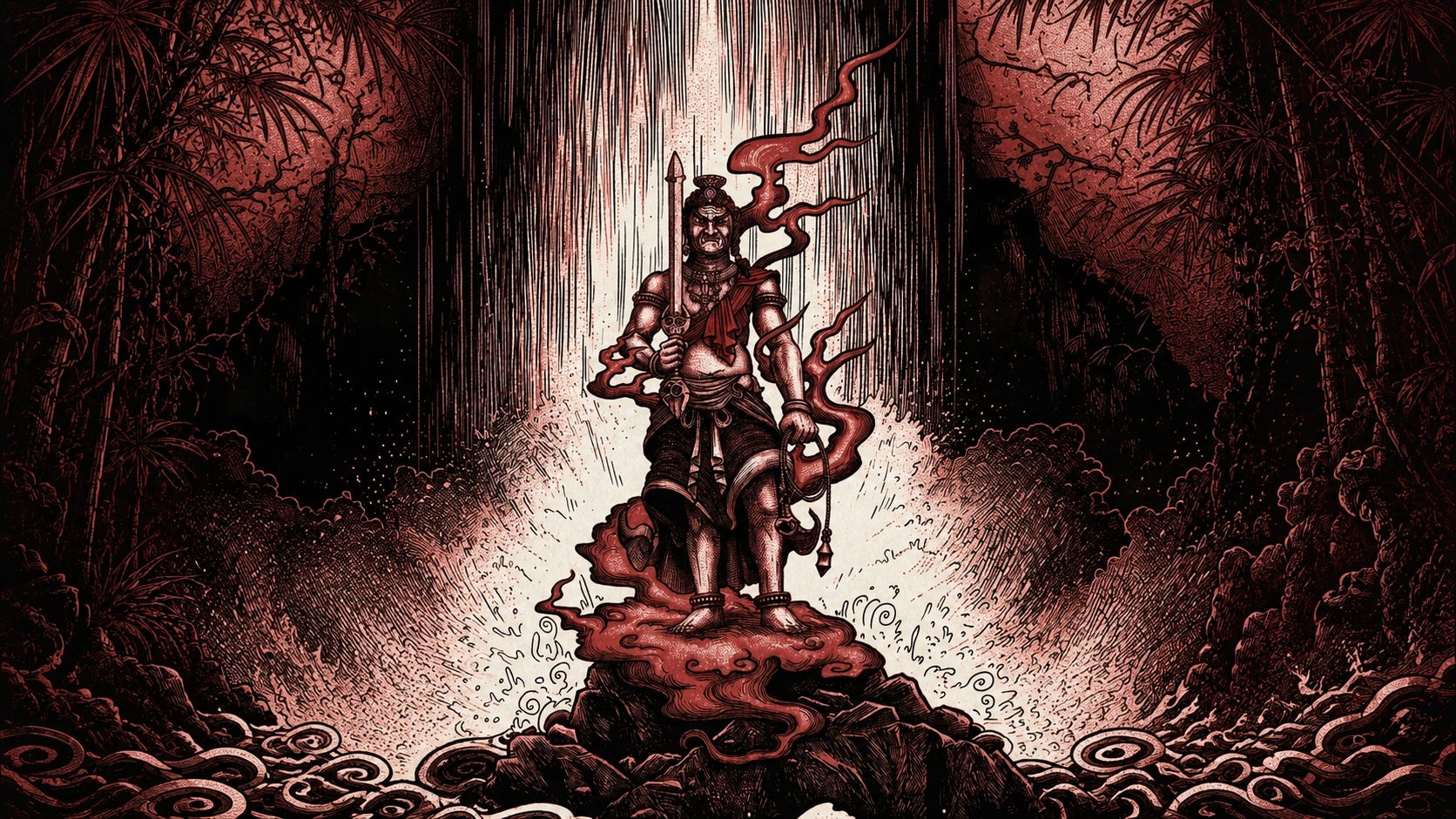
Everything around Fudō Myōō may be chaotic, but he remains unmoved, not allowing outer chaos to become his chaos. His fiery aura is not ordinary anger. It represents divine wrath, a force untouched by ego, personal gain, or petty emotion. His rage is not selfish. It burns only to destroy illusion, ignorance, and everything that keeps the spirit trapped.
This is the essence of Fudōshin, the immovable mind. It does not mean becoming emotionally numb, rigid, or incapable of change. It means developing a center that cannot easily be submitted by fear, anger, confusion, temptation, or social pressure. The person can adapt without losing himself, he can bend without collapsing, and can change direction without abandoning his deepest principles.
The Western Warrior expands his influence over the world.
The Eastern Warrior reduces the conscious and unconscious influence the world has over him.
We can picture the Indigenous warrior-shaman, whose courage is inseparable from ritual, nature, spirit, ancestry, and the invisible forces surrounding life. We can think of Arjuna in the Bhagavad Gita, standing between duty and despair, forced to confront not only an external battle, but also the confusion, attachment, grief, and moral conflict within himself. We can think of the Zen-influenced samurai, who trained not merely to defeat an opponent, but to overcome hesitation, fear, attachment, and the fragmentation of the mind.
The samurai, of course, carried both orientations. He fought outwardly, served political power, defended territory, and sometimes participated in conquest. Yet the philosophy surrounding him often turned combat into a mirror of the inner condition.
So in other words, symbolically speaking, for the eastern warrior the sword became more than a weapon; it became a test of consciousness.
Was the mind disturbed?
Was the ego attached to victory?
Was fear interfering with perception?
Was action arising from clarity, or from emotional turmoil?
The Eastern Warrior seeks to remove the inner obstacles that prevent right action. His battlefield is fear, ego, craving, illusion, the restless mind.
His victory is not always visible to the world. No empire may rise from it. No monument may be built. No crowd may applaud. Yet something important has been conquered. The person is no longer completely ruled by anger, fear, desire, pride, or attachment. This warrior tends toward humility because the deeper he enters himself, the more he sees how much remains unmastered.
He discovers enemies within himself that cannot be defeated once and forgotten… These inner enemies return in different forms. For instance, pride hides behind virtue, fear disguises itself as reason, attachment disguises itself as loyalty, and cowardice disguises itself as patience. The inner battle requires continuous awareness.
Temperament Is Not Destiny
Some may argue that extroverted people naturally become Western Warriors, while introverted people become Eastern Warriors. Yes, there may be a correlation, but correlation does not imply causation. An extroverted person may naturally express energy outwardly. An introverted person may prefer reflection, solitude, and a richer internal world, but the thing is that temperament does not determine warrior orientation. An extrovert may be socially expressive while being deeply focused on inner mastery, and an introvert may be quiet yet intensely ambitious, competitive, and directed toward external achievement. Someone may avoid attention but still spend his life building wealth, influence, status, expertise, or power. The distinction is not how loudly someone speaks, but in where his power is directed.
Does he primarily seek to transform the world?
Or does he primarily seek to transform himself?
How does he blend the two?
The Shadow of the Western Warrior
The Western Warrior can create extraordinary things, but when his outward power grows without enough inner development, his strength approaches its shadow. He may accumulate many points of power around himself. Money becomes a point of power. Property becomes a point of power. Status becomes a point of power. A company, audience, title, network, or reputation becomes a point of power. And as you can imagine, none of these things are inherently corrupt. They may be used to build, protect, educate, employ, lead, or serve. The danger appears -as I mentioned before- when external structures become substitutes for an inner structure that was never built.
For example, a person may create an empire around himself while remaining internally fragmented. He may command others but remain unable to command his impulses. He may be admired by thousands while being completely dependent on admiration. He may appear powerful because he is constantly producing, competing, and moving, while inwardly he is running away from that inner silence.
This is one reason some people become workaholics, because work is not always only discipline. Sometimes it is avoidance wearing the armor of ambition, where the next achievement keeps emptiness at a distance. The next promotion temporarily proves personal worth, and the next victory postpones the confrontation with fear, grief, shame, or unresolved pain. But the truth is that what is avoided does not disappear. Eventually, it catches up, and the person burns out. Motivation collapses. The ambitious warrior slips into apathy and discouragement because he does not know who he is when he is not achieving.
The Shadow of the Eastern Warrior
Even though it might sound counter intuitive for some, the Eastern Warrior also has a shadow. Inner work can become withdrawal, too much reflection can mutate into hesitation. Humility without grounding can become fear of visibility, and detachment without intent can become avoidance.
For example, a person may speak about inner peace while refusing to confront the world. He may endlessly examine his emotions without taking decisive action. He may call passivity patience. He may call fear humility. He may call a lack of ambition freedom from attachment. He may understand himself deeply but never transform that understanding into creation, leadership, protection, or service. All of these attitudes can become rationalizations, or carefully constructed explanations that protect the self from anxiety while preserving a flattering image of who one believes oneself to be. In such cases the mind does not merely avoid pain, rather it often disguises avoidance as wisdom.
From a psychoanalytic perspective, these are defenses of the ego. A person forms an idealized identity (peaceful, self-aware, detached, morally refined) and then unconsciously filters reality to protect it. Decisive action is avoided because action brings exposure: the possibility of failure, conflict, humiliation, responsibility, and the discovery that one may not be as courageous, capable, or enlightened as imagined. Remaining in reflection allows the fantasy of potential to survive. As long as nothing is attempted, nothing can disprove the image. In simpler words, as long as nothing is attempted, that ideal image of yourself cannot be proven wrong, so you save yourself from feeling discomfort or emotional pain. People often trade this kind of safety for truth.
This is why endless introspection can become another form of resistance. One may analyze every fear, trace every wound, and understand every emotional pattern, yet still remain unchanged. Insight then becomes a substitute for transformation. The person studies the prison so thoroughly that he begins to mistake knowledge of its walls for freedom…
So, the idea is:
Too much Western Warrior can produce outer achievements without meaning.
Too much Eastern Warrior can produce meaning without manifestation.
One may possess the world and lose himself.
The other may understand himself but never offer his strength to the world.
The Need for Integration
This is why both orientations must be cultivated:
☯️The Eastern Warrior creates the inner vessel. The Western Warrior gives its power form.
☯️The Eastern Warrior asks whether power is pure. The Western Warrior asks whether power is effective.
☯️The Eastern Warrior develops character strong enough to handle achievement, without falling apart and slipping into shadows. The Western Warrior transforms character into action and consequence.
☯️ Without the inward path, achievement can inflate the ego and make the person dependent on status, productivity, and control. Without the outward path, spiritual development can remain private, untested, and (in some cases) disconnected from responsibility.
But let us be aware there that the goal is not necessarily to create a perfect fifty-fifty balance. Different personalities and callings require different proportions. A leader, monk, activist, entrepreneur, artist, teacher, or martial artist may express these orientations differently. Furthermore, the ratio may also change across life. At one stage, a person may need to cultivate the Western Warrior and enter the world with greater force. At another, he may need to withdraw, descend inwardly, and confront what achievement has allowed him to avoid. The important thing is that neither side becomes completely abandoned.
To conclude
The Integrated (and balanced) warrior takes a different path. He does not reject self-knowledge, but neither does he worship it. He sits still enough to see through illusion, then rises to meet reality. His peace does not come from avoiding his life challenges (lessons); it comes from staying composed and centered while facing it. His humility does not deny his strength; it frees him from needing to display it. His detachment is not indifference but the ability to act completely without being controlled by praise, fear, or outcome.
True inner work eventually demands embodiment. Understanding must become discipline. Compassion must become service. Strength must become protection. Vision must become creation. Otherwise, spirituality and self-analysis risk becoming elegant shelters for the same fear people claim to have overcome.
The deepest kind of growth happens when you stop trying to protect the image of who you think you should be and are willing to let it change. You have to let go of the rigid picture of who you imagined yourself to be so that a more honest version of yourself can emerge. This process is gradual, like peeling the layers of an onion.
The integrated warrior can travel in both directions. He can enter the world to build, protect, achieve, and serve. But he can also enter himself to examine, purify, discipline, and understand the power he carries.
He can achieve without becoming psychologically dependent on achievement.
He can rest without losing direction.
He can work intensely without using work to escape himself.
He can enter solitude without withdrawing permanently from responsibility.
He builds external power without making it the foundation of his soul.
He cultivates internal strength without hiding that strength from the world.
The Eastern and Western Warrior are not at odds with each other. They are two expressions of one awakened force. One makes the spirit difficult to conquer. The other makes the will capable of outer achievement and manifestation. One stands like a mountain. The other advances like fire.
The full warrior consciousness contains both.
➡️ If this spoke to you, drop a ❤️ and pass it along to someone who may need to hear it.
📌 For those visiting for the first time: this page has a mission.
I am dedicating my life to developing practical psychological and philosophical methods around two pillars:
The Warrior’s Way of Life: integrating discipline, resilience, and timeless principles into everyday living.
Inner Work: cultivating mental health, clarity, and inner strength through self-mastery and reflection.
But this cause can achieve more, and for that, I need your support.
Your contribution helps me dedicate more time and resources to research and to share deeper work with those who seek it.
If this resonates with you, I invite you to support my cause on Substack by becoming a contributor.
🔻📕Additional Resources:
📺 👉 Latest Video:
Also, if you’ve found my article helpful and inspiring and want to delve deeper into the subjects of psychology, philosophy, the warrior ethos and zen, I recommend checking out my books:
📕➡️100 thoughts for the Inner Warrior
Whether you’re seeking personal growth, to fortify your inner strength and mental resilience, or simply a deeper understanding of the warrior ethos, “100 Thoughts for the Inner Warrior” is a valuable resource that can guide you on your journey.
This book it’s packed with proven psychological techniques to help you access your mind’s hidden reserves and build the willpower, tenacity and discipline needed to face any challenge. From strategies to quiet the inner voice of self-doubt to exercises that master the art of delayed gratification, each chapter guides you on a path toward mental, physical and emotional mastery.
📘➡️Flow - The Science and Spirit of Striking
For those of you serious about striking martial arts and want to take their skills to the next level, this book is for you. It’s not just useful, it’s transformative. Inside, you’ll find training that taps into the Flow of Body, Mind, and Spirit. Mastering all three is the key to unlocking true Flow State in combat
📓➡️8 Toxic Patterns That Keep You in Painful Loops
This book isn’t about blame, it’s about awareness and transformation.
It takes you beyond labels and trend psychology into a deep, honest exploration of the defenses, masks, and coping mechanisms you’ve built to survive shame, rejection, and abandonment.
Inside, you’ll discover eight core toxic archetypes, which are patterns we unconsciously slip into when we lose touch with our authentic selves. You’ll learn where they come from, how they shape your relationships, and how to overcome them.
👉 Furthermore, you can consider joining my WhatsApp channel via this link if you don’t want to miss future updates.
"Water can flow, or it can crash... Be water my friend." Having both succedeed in the East and the West, Bruce Lee must have been an Integrated Warrior.
Great fusion and exploration of both styles. I have been doing similar work and found that both Western and Eastern approaches complement each other. I have found Taoism, Soto Zen, and Stoic philosophy combine beautifully, and practicing these skills and concepts for many years now, and in extreme circumstances, to be most powerful and liberating. You use the warrior archetype. I developed a model and community using the Hero's archetype, as in the Hero's myth archetype, the one who chooses to take the adventure offered. Ancient myths from every culture have Hero's myths. Popular modern examples include Star Wars (the original 3 were created using Joseph Campbell's Hero's Myth model), Lord of the Rings, The Matrix, and Harry Potter. Maybe you can check out my page and we can collaborate on something in the future. Keep posting, it's great stuff people need to hear.